
The Hidden Tax of Keyword Hiring: Moving From Transactional Hiring to Strategic Workforce Building
Key takeaways
- CEOs told PwC they believe 40% of their entire hiring process is inefficient, and rank hiring as the third most inefficient process across their business.
- Keyword matching scores a resume by the percentage of job description terms it contains, then auto rejects anyone under the threshold. Candidates optimize to clear the bar, so the bar stops measuring anything.
- The result is shortlists full of people who look excellent on paper and fall short of the actual job. Every one of those calls is paid for in recruiter hours, hiring manager hours, and delay.
- Applications per hire tripled between 2021 and 2024. Technical roles now take 17.6 interviews and 23.3 interview hours per hire, and about 10 weeks to first fill. When a hire fails, that clock starts over.
- According to SHRM, the cost of replacing an employee can range from 50% to 200% of their annual salary, depending on their level.
- The fix is not a faster version of the same process. It is a shift from transactional hiring to strategic workforce building, where evaluation produces real hiring signal before the first conversation.
Hiring is not just slow. It is structurally inefficient.
PwC's global CEO survey produced a number that should stop any executive team: CEOs believe 40% of their entire hiring process is inefficient, and they see hiring as the third most inefficient process across their businesses.1
Sit with that. Not 40% of hires are bad. Forty percent of the process is waste. That is not a talent acquisition problem to be solved with better outreach or a bigger job board budget. That is a structural drag on every business objective that depends on having the right people in the right seats.
And most of it traces back to a single design decision baked into the systems nearly everyone runs on: score candidates by counting words.
How does keyword matching actually decide who gets a call?
The mechanics are simpler than the marketing suggests.
A candidate applies. The system reads the resume, reads the job description, and calculates what percentage of the job description's terms appear in the resume. That percentage becomes the score. Candidates above a threshold move into the review pile. Candidates below it are filtered out, deprioritized, or auto rejected outright.
That is the entire evaluation. There is no assessment of whether the person did the work, at what scale, or how well. There is only overlap.
Which means the moment candidates figured out the rule, the rule stopped working.
Gamification did not break the system. It revealed that the system was never measuring anything.
Once a score can be reverse engineered, optimizing for it is rational behavior. Candidates now run their resume against the posting, get a match percentage, add the missing terms, and resubmit. It takes minutes. It costs nothing.
So the threshold gets cleared. Reliably. By the people who know the game exists.
Here is the part that hurts: the score still goes up, but it no longer correlates with anything. Your shortlist is now sorted by resume optimization skill, which has close to zero relationship with whether someone can do the job.
Recruiters and hiring teams are left calling candidates who are not qualified for the role they are hiring for. Not because anyone made a bad judgment call, but because the list they were handed was assembled by a system measuring the wrong thing. The candidates look stellar on paper. They fall short of basic job expectations twenty minutes into the first conversation.
Meanwhile the genuinely qualified applicant who wrote an honest, unoptimized resume sits at 61% and never gets read.
The cost is not the job ad. It is everything downstream.
When talent leaders calculate the cost of a req, they usually think about advertising spend and agency fees. Those are the cheapest line items in the whole process.
The real cost is what the bad shortlist consumes after it is handed over.
Look at what a single hire now demands. According to Ashby's talent trends data, applications per hire tripled from 2021 to 2024, rising from roughly 100 in early 2021 to a peak of 319. Throughout 2025, every hire required more than 300 applications on average, and the average recruiter today is processing 291. Candidates are now roughly 50% less likely to receive an interview than they were five years ago: in 2021 about 7 to 8 percent of applications resulted in an interview, and today that figure sits between 3.6 and 4.7 percent depending on role type.2
More volume, thinner conversion, and the same recruiters absorbing it.
Then the interviews themselves. These are totals per hire, counting every candidate your team interviewed for the role, not just the one who got the offer:
- Business roles: 11.7 interviews per hire, up 36% from 2021, at 12.2 hours of total interview time
- Technical roles: 17.6 interviews per hire, up 52% from 2021, at 23.3 hours
- Data roles: 19.5 interviews per hire, the most of any category, at 24.9 hours2
Those hours are not recruiter hours alone. They are senior engineer hours, director hours, hiring manager hours. They are the most expensive hours in the company, spent interviewing people a better evaluation would have filtered out before anyone picked up the phone.
Every unqualified call is time that could have gone to shipping product, serving customers, or closing revenue. That is the compounding effect, and almost no organization tracks it.
Every failed process restarts the clock
Time to hire is where the damage becomes visible on a calendar.
Ashby's data puts time to first fill at 8 weeks for business roles and 10 weeks for technical roles.2 That is the number when things go according to plan.
They frequently do not. A shortlist built on keyword scores produces finalists who do not clear the bar, offers that get declined, and hires who wash out in the first quarter. When that happens, the clock does not pause. It resets. Sourcing restarts, screening restarts, the interview panel reassembles.
Two cycles on a technical role is roughly five months from open req to a person actually doing the work. In a market where AI is compressing product cycles into weeks, five months is not an inconvenience. It is a competitive loss.
The mandate has changed. Businesses no longer have the bandwidth to wait two, three, or six months for a seat to be filled. They need faster placements and better qualified candidates at the same time, which the current process treats as a tradeoff.
What a bad hire actually costs
If the candidate makes it through and turns out to be wrong for the role, the bill grows again.
According to SHRM, the cost of replacing an employee can range from 50% to 200% of their annual salary, depending on their level.3 For a senior hire at the top of that range, that is the full cost of the role paid twice with nothing delivered in return.
And salary replacement is only the piece that shows up in a spreadsheet. Here is how we model the full picture at Kreativs.
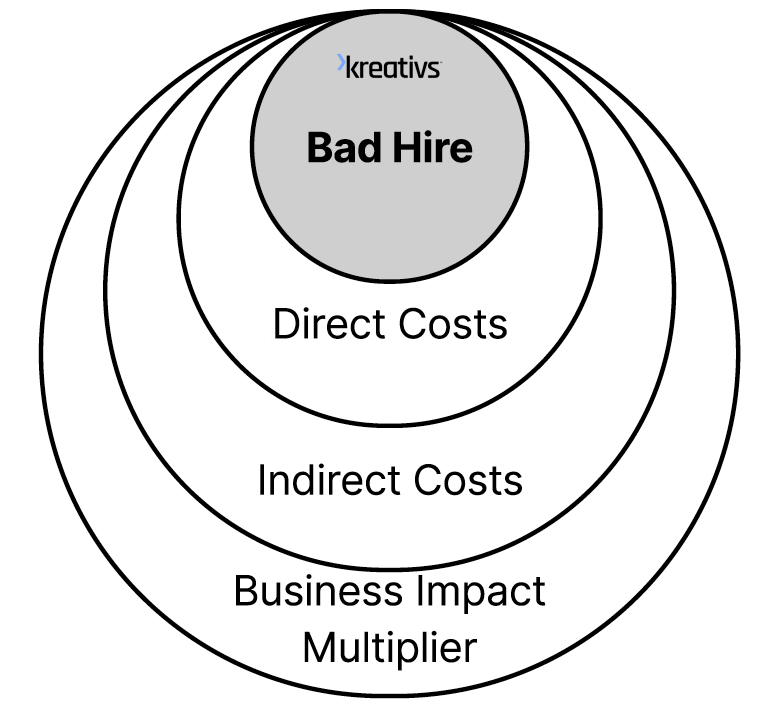
True Cost of a Bad Hire = (Direct Costs + Indirect Costs) × Business Impact Multiplier
Direct costs
- Replacement cost: what it takes to source, hire, and onboard the replacement
- Opportunity cost: delayed projects and missed market windows
- Lost revenue: customer churn and failed execution
Indirect costs
- Team impact: morale decline and the turnover risk that follows
- Project failure risk: missed deadlines and quality problems
The multiplier is what most models leave out entirely. A wrong hire on a two-person team building your core product does not cost the same as a wrong hire in a twenty-person function with slack in it. Same salary, wildly different consequence. Business impact is not a rounding factor. It is the term that determines the magnitude.
Very few organizations track any of this, which is exactly why the inefficiency persists. A cost nobody measures is a cost nobody fixes.
From transactional hiring to strategic workforce building
This is the shift we think the industry has to make, and it is bigger than a tooling upgrade.
Transactional hiring treats a req as a ticket to be closed. A seat opened, so fill the seat. Score the resumes, book the calls, extend the offer, move to the next one. Speed of closure is the metric.
Strategic workforce building treats hiring as what it actually is: the mechanism by which an organization builds the capability to sustain and grow. Every business needs a healthy workforce to avoid taking losses, whether it is a public company, a private firm, a nonprofit, or a government agency. That is not an HR aspiration. It is an operating requirement.
You cannot build strategically on a process that selects for resume optimization. Strategic requires two things transactional hiring does not have: objectivity, so the same candidate gets the same read regardless of who is looking or what day it is, and evidence, so a decision can be explained in terms of what a person has actually done.
Where AI is genuinely good, and where the skepticism is fair
Plenty of talent leaders are skeptical of AI in hiring. That skepticism is healthy and largely earned. Too many products have promised judgment and delivered a scoreboard with no reasoning behind it.
But it is worth being precise about what the technology is actually good at, because the answer is narrower and more useful than the marketing suggests.
AI is exceptional at reading. Deep learning and semantic understanding are, at their core, the ability to interpret written language and extract meaning from it, including meaning that is implied rather than stated. That is not a hypothetical strength. It is the single capability these systems are best at.
A resume is written language. It is precisely the kind of input this technology handles well, and precisely the kind of input keyword matching handles badly.
So the useful question is not "should AI make hiring decisions." It should not, and at Kreativs it does not. The useful question is: can AI read a candidate's history the way an experienced practitioner would, consistently, at volume, before anyone spends an hour on a call? That, it can do.
Treating every candidate as a data card
The difference in how we approach this comes down to one idea.
We treat each resume as a data card: a structured record of a real person's delivery, skills, scope, and trajectory. That card can be read, interpreted, and assessed with high confidence against what the role actually requires. Not matched. Assessed.
The output is a substantiated read on what the candidate has delivered, what their experience genuinely evidences, and where they are incomplete for this specific role. Every assessment carries the reasoning behind it. Nobody is auto disqualified, and a human makes the decision about who moves forward.
What that changes in practice is the starting point of every conversation. Your recruiter opens the first call already knowing the candidate, instead of using the call to find out who they are. The interview process becomes precise and proactive rather than reactive. You are not discovering disqualifiers in week three of a panel. You knew before you dialed.
We launched this capability over a year ago, built on context and semantic understanding rather than AI layered on top of keyword matching. We did not think you could patch your way from one to the other, and nothing we have seen since has changed our mind.
What the ROI actually looks like
The return shows up in three places at once, which is unusual and worth being specific about.
- Fewer wasted conversations. When the shortlist starts from evidence, the people on it can do the job. Recruiter and hiring manager hours stop being spent on candidates who were never viable.
- A clock that does not reset. Fewer failed searches and fewer early exits mean fewer full restarts, which is where the largest single block of time disappears.
- Decisions that can be defended. "Advanced on this delivery evidence, flagged on this gap" survives a conversation with a hiring manager, a compliance review, and a candidate asking why. A percentage match never did.
Underneath all three is the same thing: competitiveness. AI is accelerating delivery timelines across every function in the business. The companies that can identify and secure the right people in weeks rather than quarters will simply out-execute the ones that cannot. Hiring speed has become an operating advantage, and you cannot get it by rushing a broken process. You get it by starting from a better shortlist.
This is what we have seen with the customers who piloted our platform and are running on it today.
Stop paying a tax you are not measuring
Forty percent of the hiring process is inefficient, by the estimate of the people running these companies. That inefficiency is not evenly distributed across the funnel. A disproportionate share of it sits in one place: the decision about who is worth a conversation, made by a system that counts words.
Everything downstream inherits that error. The wasted interview hours, the resets, the replacement costs, the business impact multiplier compounding quietly on top of all of it.
The way out is not a stricter threshold or a faster funnel. It is a different starting point. Understand the candidate first, from evidence, before the first email goes out. Then let your recruiters do what they are good at, which is judgment applied to real information.
That is the move from transactional hiring to strategic workforce building, and it is available now.
Want the numbers behind this? Talk to us today to see the value of hiring with upfront signal, and what it costs to keep doing business the old way.
FAQ
Sources
- Jack Dimond, "CEOs think almost half of the hiring process is inefficient," Paradox, January 31, 2024, reporting on PwC Global CEO Survey data. https://www.paradox.ai/blog/ceos-think-almost-half-of-the-hiring-process-is-inefficient-heres-why-and-how-to-fix-it
- Ashby, "Recruiter Productivity," 2026 Talent Trends Report, covering January 2021 through March 2026. https://www.ashbyhq.com/talent-trends-report/reports/2023-recruiter-productivity-trends-report
- Regina Dyerly, "The Myth of Replaceability: Preparing for the Loss of Key Employees," SHRM Executive Network, January 21, 2025. https://www.shrm.org/executive-network/insights/myth-replaceability-preparing-loss-key-employees